
MENU
MENU

%20(1)%20(1)%20(1).avif)

You want a treadmill. You've done a quick search, seen the price range go from ₹20,000 to ₹5,00,000+, and now you're more confused than when you started. That's completely normal. The gap between a treadmill for home use and a commercial gym treadmill is massive in build quality, motor power, belt size, warranty terms, and of course, price.
This guide breaks it all down so you can make a confident, well-informed decision before spending a single rupee.
A home treadmill is designed for personal use typically one to three users running a few sessions per day. Manufacturers build these machines for moderate frequency, not round-the-clock demand.
Key characteristics of home treadmills:
Home treadmills are compact, quieter, and lighter. They work well for walking, jogging, and moderate running. Many also fold up vertically, which makes them suitable for apartments and smaller rooms.
A commercial gym treadmill is engineered to handle continuous, heavy use — think 8 to 16 hours of daily operation across multiple users. You'll find these in gyms, hotels, corporate fitness centers, and rehabilitation clinics.
Key characteristics of commercial treadmills:
Commercial treadmills do not fold. They are heavier, often 120 kg to 200 kg and need a dedicated floor space of roughly 2 m x 1 m. They are built to last 10–15 years with proper servicing.
Here is a quick breakdown of the main differences:
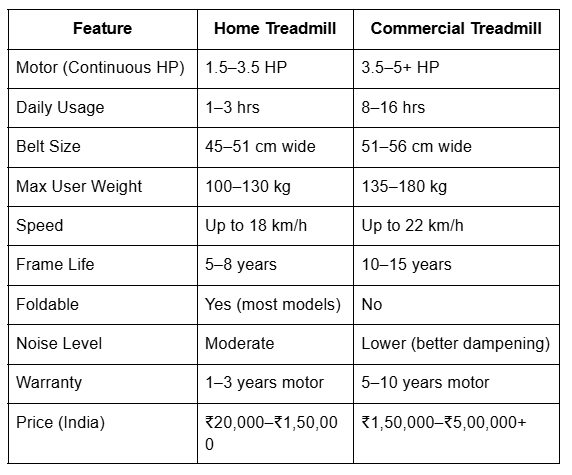
Commercial treadmill price in India varies based on motor power, belt size, console type, and brand. Here's a general price map:
The commercial treadmill price in India has become more accessible in recent years because of domestic manufacturers. Brands like Jerai Fitness produce commercial-grade treadmills in India, which reduces import costs and makes professional equipment more within reach for gym owners across the country.
Home treadmill price in India typically falls into three buckets:
One thing to watch: never go purely by the HP number in marketing materials. Always look at continuous duty HP, not peak HP. A treadmill marketed as "5 HP" may only deliver 1.75 HP continuously that's the number that matters during actual use.
Let's break it down to the factors that decide which type suits your situation.
1. Motor Durability Under Load
A home treadmill motor runs comfortably at 60–70% of its rated load. Push it beyond that daily, and you'll face overheating, premature wear, and costly repairs. A commercial treadmill motor is designed to run at 80–90% capacity for hours without strain. If you're setting up a gym where equipment runs back-to-back, a home treadmill simply won't last.
2. Deck and Belt Longevity
Commercial treadmill decks use thicker multi-ply belts (often 4-ply vs 2-ply in home models) and reversible decks that double the usable surface life. The cushioning systems on commercial models use multi-point orthopaedic shock absorbers, reducing joint stress for users who train frequently.
3. Safety and Weight Capacity
For a gym with users of varying body weights, you need a machine rated for at least 135–150 kg. Home treadmills rated at 100–110 kg can be dangerous when used by heavier individuals at high speeds. Commercial treadmills have wider emergency stop rails and more robust safety clip systems.
4. Space and Installation
A home treadmill can sit in a bedroom corner. A commercial gym treadmill needs a fixed, rubber-floored space with proper ventilation and easy access for maintenance. Factor in space when comparing home treadmill vs commercial treadmill for your fitness goal.
5. Total Cost of Ownership
A ₹60,000 home treadmill replaced every 4–5 years in a busy gym costs far more over a decade than one ₹2,50,000 commercial unit that runs 10–12 years. For home use with one or two users, the math flips. Buying a commercial treadmill for home is usually unnecessary spending unless you run high mileage daily.
A treadmill for home use makes sense if you match most of these:
For most Indian households, a good quality mid-range home treadmill from a trusted manufacturer covers all training needs without the added cost of commercial-grade hardware.
A commercial treadmill is the right choice if:
Gym owners searching for the best treadmill for home vs gym use should weigh the daily usage hours above all other factors. That single metric determines more about long-term value than any other specification.
Technically, yes. But here's the practical reality:
Unless you are a serious marathon runner doing 15+ km daily, or you have a large dedicated home gym space, a commercial unit at home is overkill. Spend the extra money on a premium home model instead.
Use this checklist when comparing models:
Brands like Jerai Fitness carry ISO 9001:2015, ISO 14001:2015, and ISO 45001:2018 certifications from their Mumbai-based manufacturing facility, and their treadmill range covers both home and commercial categories useful when comparing specs side by side for a treadmill buying guide in India.
Choose a home treadmill if: You're an individual or family buyer, use it 1–2 hours daily, have limited space, and want value for money under ₹1,50,000.
Choose a commercial gym treadmill if: You're a gym owner or facility manager, need 6–16 hours of daily use, require high weight capacity, and want a long service life with professional warranty coverage.
Not sure? Use the daily usage hours rule:
Q1. What is the main difference between a home treadmill and a commercial treadmill?
The main difference comes down to motor durability, belt thickness, and daily usage capacity. Home treadmills handle 1–3 hours of use per day across one to three users. Commercial treadmills are built for 8–16 hours of daily use, carry higher user weight ratings, and come with longer warranties on motor and frame. The commercial treadmill price in India also reflects this durability gap significantly.
Q2. What is a reasonable home treadmill price in India for a good quality machine?
For a solid home treadmill in India, expect to spend ₹50,000 to ₹1,00,000 for a reliable mid-range model. This range gets you a 2.5–3.5 HP continuous motor, auto incline, orthopedic cushioning, and a user weight capacity around 120 kg. Budget models under ₹30,000 exist but often have weaker motors and shorter lifespans.
Q3. Can I buy a commercial gym treadmill for home use?
You can, but it usually isn't worth it for home users. Commercial treadmills weigh 120–200 kg, don't fold, and cost ₹1,50,000 to ₹5,00,000+. For one or two home users running under two hours daily, a premium home treadmill delivers the same performance at a fraction of the cost. Save the commercial budget for actual gym setups.
Q4. How long does a home treadmill last compared to a commercial treadmill?
A good quality home treadmill lasts 5–8 years with regular maintenance and moderate daily use. A commercial treadmill, when serviced properly, lasts 10–15 years even under heavy gym use. The deck, belt, and motor on commercial models are built to much higher tolerances, which explains the higher commercial treadmill price in India.
Q5. Which treadmill is best for a small gym startup in India?
For a small gym or boutique fitness studio with moderate footfall, an entry-level commercial treadmill in the ₹1,50,000–₹2,50,000 range is the right starting point. Look for a minimum 3.5 HP motor, 51 cm belt width, 150 kg user capacity, and at least a 5-year motor warranty. Brands like Jerai Fitness offer commercial cardio equipment manufactured in India with certified quality standards and pan-India service support.
.avif)

.avif)


%20(1).avif)