
MENU
MENU

%20(1)%20(1)%20(1).avif)

If you've been thinking about buying a treadmill, you already know the feeling: too many options, confusing specs, and prices that vary wildly from one brand to the next. Whether you want to run at home or kit out a commercial gym, this guide breaks it all down so you can make a smart, informed purchase.
Let's start with the basics, then work our way through features, price ranges, and where to actually buy one in India.
Treadmills have been around for decades, and they continue to outsell almost every other piece of cardio equipment. The reason is simple: walking and running are natural movements. You don't need to learn a new motion or adjust your form from scratch. You just get on and go.
For home use, a treadmill is one of the most practical pieces of gym equipment you can own. You can walk while catching up on a show, run your daily 5K regardless of the weather, or follow a structured interval training program, all without leaving your house.
For commercial gyms, treadmills are non-negotiable. Members expect them, and they see consistent daily use. That means the machine needs to be tough, reliable, and comfortable for users of all fitness levels.
These don't have a motor. The belt moves because you push it with your feet. They're cheaper, quieter, and need almost no maintenance. The trade-off is that they're harder to use at consistent speeds and aren't suitable for running.
Best for: Light walkers, small budgets, or people with limited space.
These have an electric motor that drives the belt. You set the speed and incline on a console, and the machine does the rest. Most home and commercial treadmills fall into this category.
Best for: Serious walkers, joggers, runners, and gym owners.
A motorized treadmill where the deck folds up when not in use. Great for smaller apartments where space matters.
Best for: Home users with limited floor space.
Built for heavy daily use, commercial treadmills have stronger motors, longer warranties, and more durable frames. They cost significantly more but are designed to handle thousands of hours of use.
Best for: Gyms, fitness centers, hotels, and corporate wellness spaces.
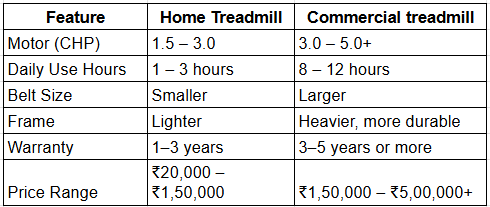
Here is a straightforward look at the specs that actually matter:
The motor is the heart of any motorized treadmill. Look at the continuous horsepower (CHP), not the peak horsepower rating, which can be misleading.
A weak motor overheats under stress, wears out faster, and delivers a choppy, inconsistent belt speed.
The belt size determines how comfortable your stride feels. A belt that's too narrow or short forces you to shorten your stride.
A treadmill with incline settings gives you a much broader range of workouts. Walking at a 10–12% incline burns nearly as many calories as jogging on a flat surface, with far less impact on your joints.
Most quality treadmills offer 0–15% incline. Some premium models include decline settings as well.
Make sure the treadmill you choose can comfortably reach your target speed without the motor straining.
Joint impact is a real concern for regular treadmill users. A good cushioning system reduces the shock transmitted to your knees, hips, and ankles. This matters more for runners than walkers.
At the basic level, you want to see speed, time, distance, and calories burned. Better treadmills add heart rate monitoring, pre-set workout programs, Bluetooth connectivity, and touchscreen displays.
Every treadmill has a maximum user weight. Don't ignore this. Exceeding it puts stress on the frame and motor and voids your warranty. Most home models support up to 100–120 kg, while commercial ones go up to 150–180 kg.
Treadmill prices in India vary based on type, motor quality, brand, and features. Here's a broad breakdown to set expectations:
Manual treadmills and entry-level motorized treadmills with small motors (1.5–2.0 HP), basic displays, and limited speed/incline options. These are fine for light walking but not suitable for running or intense workouts.
Motorized treadmills with decent motors (2.0–3.0 CHP), foldable designs, auto-incline, heart rate sensors, and digital displays. A solid choice for home users who jog or run a few times per week.
Stronger motors, wider belts, better cushioning, app connectivity, and touchscreen consoles. These are built for daily serious runners and offer features close to commercial-grade quality.
Heavy-duty frames, 3.0–5.0 CHP motors, long belts, robust cushioning, and warranties that cover commercial use. These treadmills are built for gyms where the machine runs for 8–12 hours daily.
Measure your available floor space before you order anything. A standard treadmill is roughly 180–200 cm long and 80–90 cm wide. Add at least 60 cm behind the machine for safety. If space is tight, a folding model can help.
Motor noise can be an issue if you live in an apartment or have family members sleeping nearby. Brushless motors and good belt cushioning generally produce less noise. Reading reviews about noise levels is time well spent.
A treadmill is a mechanical product. Things can go wrong. Check the warranty terms carefully, especially what's covered: motor, frame, parts, and labor. Also confirm that the brand has service support in your city.
Stick to established brands with a track record in India. A cheap treadmill from an unknown seller might work fine for a few months, then break down when you can't get spare parts or a technician.
You can buy treadmills from major e-commerce platforms like Amazon and Flipkart. You'll find a wide range, competitive prices, and the convenience of home delivery. That said, for a significant purchase like a treadmill, buying directly from the manufacturer or an authorized dealer is usually a better move. You get accurate product information, proper installation support, and reliable after-sales service.
Jerai Fitness is one of India's well-known gym equipment manufacturers, based in Mumbai, with a product range that covers both home and commercial treadmills. Their treadmill lineup includes models across different series designed for varying use cases, from personal home training to full-scale commercial gyms. They also have showrooms and dealer networks across major Indian cities including Delhi, Bengaluru, Hyderabad, Pune, Ahmedabad, and more.
You can browse their treadmill range, check specifications, and make an enquiry directly at website.
When buying a treadmill online in India, here's a quick checklist:
Buying the right machine is step one. Keeping it running well is step two.
How to choose the right treadmill, Answer these four questions to narrow down your options:
For regular home use involving jogging and running, a budget of ₹40,000 to ₹80,000 will get you a motorized treadmill with a solid motor (2.0–3.0 CHP), decent belt size, and incline options. Budget below ₹30,000 is better suited for light walkers only.
For running, you need a minimum of 2.5 CHP (continuous horsepower). If multiple people will use the machine or if the user is heavier, aim for 3.0 CHP or above. Always look at the CHP rating, not peak horsepower, which can be misleading.
Yes, buying a treadmill online is safe if you purchase from reputable platforms or directly from established manufacturers like Jerai Fitness. Always check the warranty terms, whether installation is included, and what the return policy looks like before placing your order.
Home treadmills are built for 1–3 hours of daily use by one or two users. Commercial treadmills are engineered for 8–12 hours of continuous use in gyms, with stronger motors, wider belts, heavier frames, and longer warranties. Commercial models cost significantly more but are far more durable.
A standard treadmill needs roughly 200 cm x 90 cm of floor space, plus 60 cm behind the machine as a safety clearance. For small apartments, a folding treadmill is a practical solution as it can be stored upright when not in use, freeing up floor space.
.avif)

.avif)


%20(1).avif)